

The term ”data controller” has been defined in the General Data Protection Regulation (GDPR). The GDPR, at its most basic, specifies how personal data should be lawfully processed and sets a number of legal requirements that fall on data controllers.
What is a data controller?
The data controller means any person or legal entity involved in determining the purpose and ways of processing the personal data.
Data controller vs processor
Under the GDPR, the term ”data processor” means any person or legal entity involved in processing personal data on behalf of the controller.
💡 Example: an internet company collects user data via their website and stores it using a 3rd party cloud service. In this scenario, the internet company is the controller and the cloud service company is the processor.
In simple terms, the processor handles personal data on behalf of the controller and not for their own purposes.
👉 Learn more about the guidelines for the relationship between data controllers and processors in our quick guide about GDPR Article 28.
Identifying details
💡 You must include the identifying details of the controller in your privacy policy.
Indien de eigenaar specifiek een rechtspersoon is, is het absoluut noodzakelijk om de persoonlijke informatie aan te geven, naast de vestigingsplaats of het kantooradres en de contactgegevens. Voorbeeld:
iubenda s.r.l – Via Torino, 2 – 20123 Milaan (Italië)
info@iubenda.com
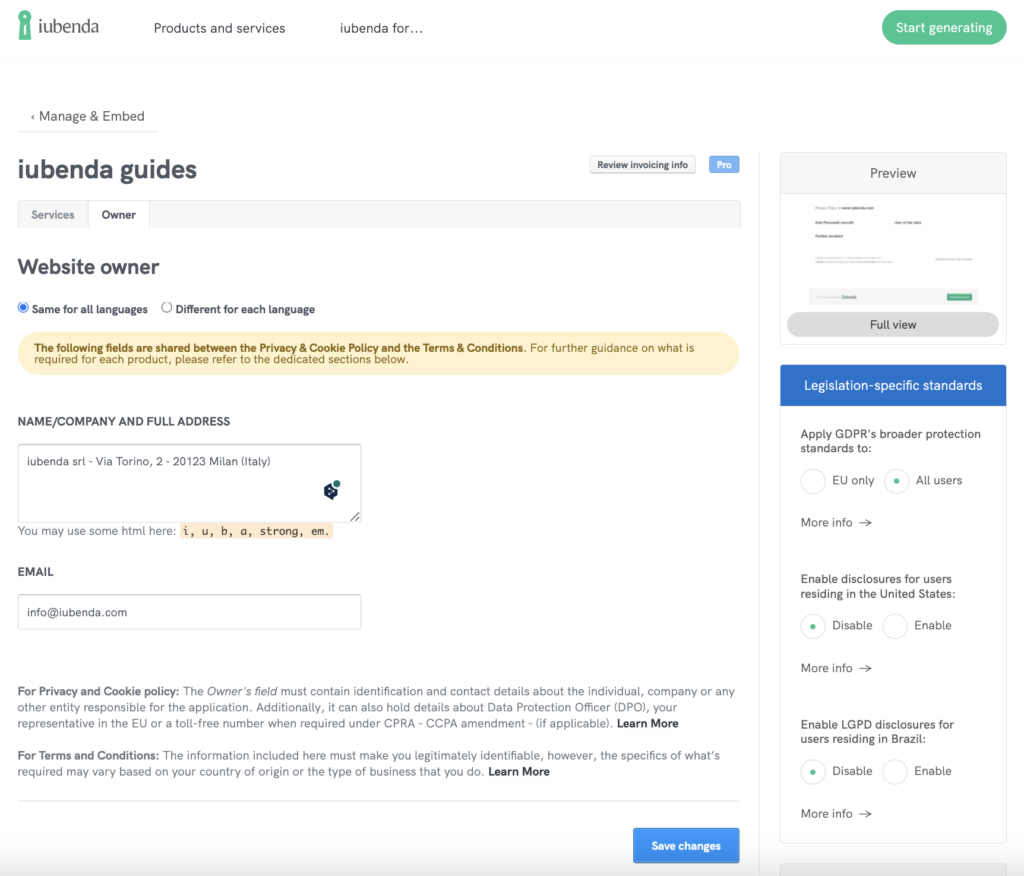
See the data controller field of iubenda’s Privacy and Cookie Policy Generator below:
Moet de vestigingsplaats/kantooradres ook worden verstrekt als de eigenaar een natuurlijke persoon is?
If the controller is a natural person, for example, a freelancer, and the relevant legislation does not provide specific indications in this regard, the data controller must, in any case, provide all the data necessary for unequivocal identification.
It is for this reason we suggest that individuals disclose personal details, residence and contact details.
Behalve in specifieke situaties die in de toepasselijke wetgeving zijn voorzien, kan de vermelding van gegevens als je woon- of vestigingsplaats alleen achterwege blijven wanneer op een andere geldige wijze aan het vereiste van ondubbelzinnige identificatie is voldaan.
Curious to know if your privacy policy is complete?
Drafting a privacy policy is complicated! It has to include a big amount of information for being legally compliant and valid. Check this out: