

Google AdSense may utilize user data for advertising communication purposes by tracking user interactions with your content and with ads. This is why, in accordance with most countries’ privacy laws, Google requires you to have a privacy policy if you use Google products like Google AdSense and a cookie management solution where applicable (especially if running personalized ads).
Lorsque vous vous inscrivez à Google AdSense, vous acceptez d’ailleurs ses conditions d’utilisation qui indiquent, à la section « 10. Vie privée » :
Our privacy policy explains how we treat your personal data and protect your privacy when you use our Services. By using our Services, you agree that Google can use such data in accordance with our privacy policy. You and Google also agree to the Google Ads Controller-Controller Data Protection Terms.
You will ensure that at all times you use the Services, the Properties have a clearly labeled and easily accessible privacy policy that provides end users with clear and comprehensive information about cookies, device-specific information, location information and other information stored on, accessed on, or collected from end users’ devices in connection with the Services, including, as applicable, information about end users’ options for cookie management. You will use commercially reasonable efforts to ensure that an end user gives consent to the storing and accessing of cookies, device-specific information, location information, or other information on the end user’s device in connection with the Services where such consent is required by law.
This means that – aside from likely breaking the law – not having a privacy policy would also put you in violation of the Terms you agreed to with Google.
Que devez-vous donc faire et quelles sont les lois applicables ?
- Create a legally compliant privacy policy. Read the specifics [below].
- Ensure that the privacy policy includes clauses specific to the processing activities handled via Google AdSense.
- Include a cookie policy. From the quote above, you’ll note that in addition to the general privacy policy requirement, Google further requires that you include notice of your use of cookies as well.
- Handle cookies and consent to cookies in a legally compliant way. This generally means informing users of the use of cookies (as mentioned in the previous point), obtaining consent to the use of cookies and maintaining proof of that consent.
Generally, the national/regional laws of your base of operations will apply, as well as (in many cases), the laws governing the regions in which your users are based. This can be quite tricky online, as, unless you’re actively blocking some regions, you may need to address requirements across geographical boundaries and legal jurisdictions. For this reason, it’s always the best idea to handle these activities with the strictest applicable regulations in mind (which currently, is likely European Law, mainly the GDPR and Cookie Law).
You can read more about determining your law of reference here or read our in-depth Legal Overview Guide here.
Exemple de politique de confidentialité pour Google AdSense
De nombreuses personnes demandent des exemples de politique de confidentialité pour leurs sites ou applications et pour Google AdSense. Le contenu exact de votre politique de confidentialité dépend du droit qui vous est applicable et des spécificités de vos activités de traitement.
Il est donc conseillé, comme indiqué ci-dessus, d’aborder votre politique de confidentialité (exigée par la loi) en tenant compte des règles en vigueur les plus strictes.
Commençons par les exigences légales élémentaires. Une politique de confidentialité doit au minimum répondre aux questions suivantes :
- Who is the site/app owner?
- What data is being collected? How is that data being collected?
- What is the Legal basis for the collection? (e.g consent, necessary for your service, legal obligation etc.) – This is more specifically related to the GDPR and EU Law, however, even if you fall outside of GDPR obligations, under most countries’ legislations, you’ll still need to say why you’re processing the personal data of users.
- For which specific purposes are the data collected? Analytics? Email Marketing?
- Which third parties will have access to the information? Will any third party collect data through widgets (e.g. social buttons) and integrations (e.g. Facebook Connect)?
- What rights do users have? Can they request to see the data you have on them, can they request to rectify, erase or block their data? (under European regulations most of this is mandatory)
- Description of process for notifying users and visitors of changes or updates to the privacy policy
- Effective date of the privacy policy
Mise en garde
Gardez à l’esprit que l’exemple de texte ci-dessus ne tient pas compte du contexte spécifique de votre site et qu’il ne constituerait donc pas une politique de confidentialité efficace sans modification, car les documents juridiques ne sont valables que lorsqu’ils sont rédigés correctements.
Comment créer une politique de confidentialité pour Google AdSense
Here’s where our Privacy and Cookie Policy Generator comes in very handy: with 1700+ available clauses, our privacy policies contain all elements commonly required across many regions and services, while applying the strictest standards by default – giving you the option to fully customize as needed.
Our policies are created by lawyers, monitored by our lawyers and hosted on our servers to ensure that they are always up-to-date with the latest legal changes and third-party requirements.
Le processus est simple et intuitif :
- Add any service you may be using. In this case, it will be Google AdSense

- Fill out your web/app owner and contact details
- Add the iubenda Privacy Policy to your site (a best practice is to link to your privacy policy from your footer, as you’re legally required to make the policy easily accessible from every page of your site or app)
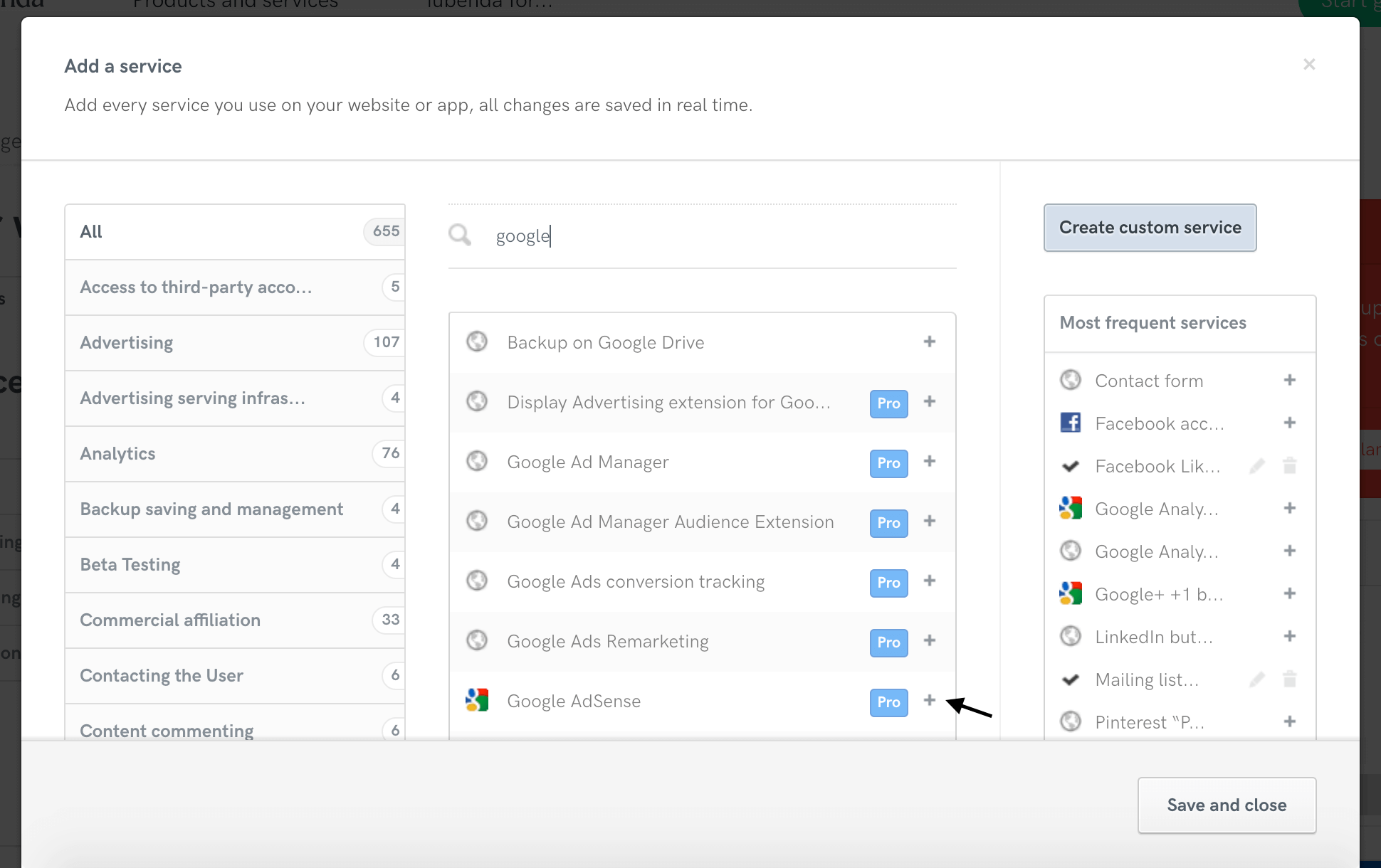
Remarque : La clause consacrée à AdSense est un service PRO que vous pouvez facilement insérer si vous disposez d’un compte payant. La clause consacrée à Google Analytics peut être insérée avec un compte gratuit.
Comment gérer l’utilisation des cookies
Comme nous l’avons mentionné plus haut, vous devez satisfaire deux sortes d’exigences : celles de Google et celles de la Loi cookies. Heureusement, ces exigences se recoupent et vous pouvez facilement les satisfaire en même temps grâce à notre solution complète de gestion des cookies, Cookie Solution.
Our Cookie Solution allows you to:
- easily inform users via banner and a dedicated cookie policy page (which is automatically linked to your privacy policy and integrates what’s necessary for cookie law compliance);
- obtain and save cookie consent settings;
- preventively block scripts prior to consent; and
- keep track of consent and save consent settings for each user for up to 12 months from the last site visit.
You can collect consent via multiple mechanisms including continued browsing, scrolling, and/ or specific clicking actions. Keep in mind though that allowed consenting actions may differ depending on the Member State law.
Le processus est simple et intuitif :
After creating your account simply go to your website area:
- click on “Generate Now” under Cookie Solution;
- configure and customize as you’d like;
- integrate your cookie policy; and
- embed into your site.
It’s easy to run, fast and does not require heavy investments. For more information on our Cookie Solution click here.
Please note: if you run personalized ads using Google services like AdSense and Google Publisher Tag, you’re required to ensure that explicit consent to ad personalization is collected before displaying personalized ads for end-users based in the EAA. Where this requirement is not met, Google will default to serving your EEA end-users with non-personalized ads, potentially impacting your ad revenue. Find full details in the dedicated guide here.